AI Hallucination: What It Is, Why It Happens, and How to Reduce It
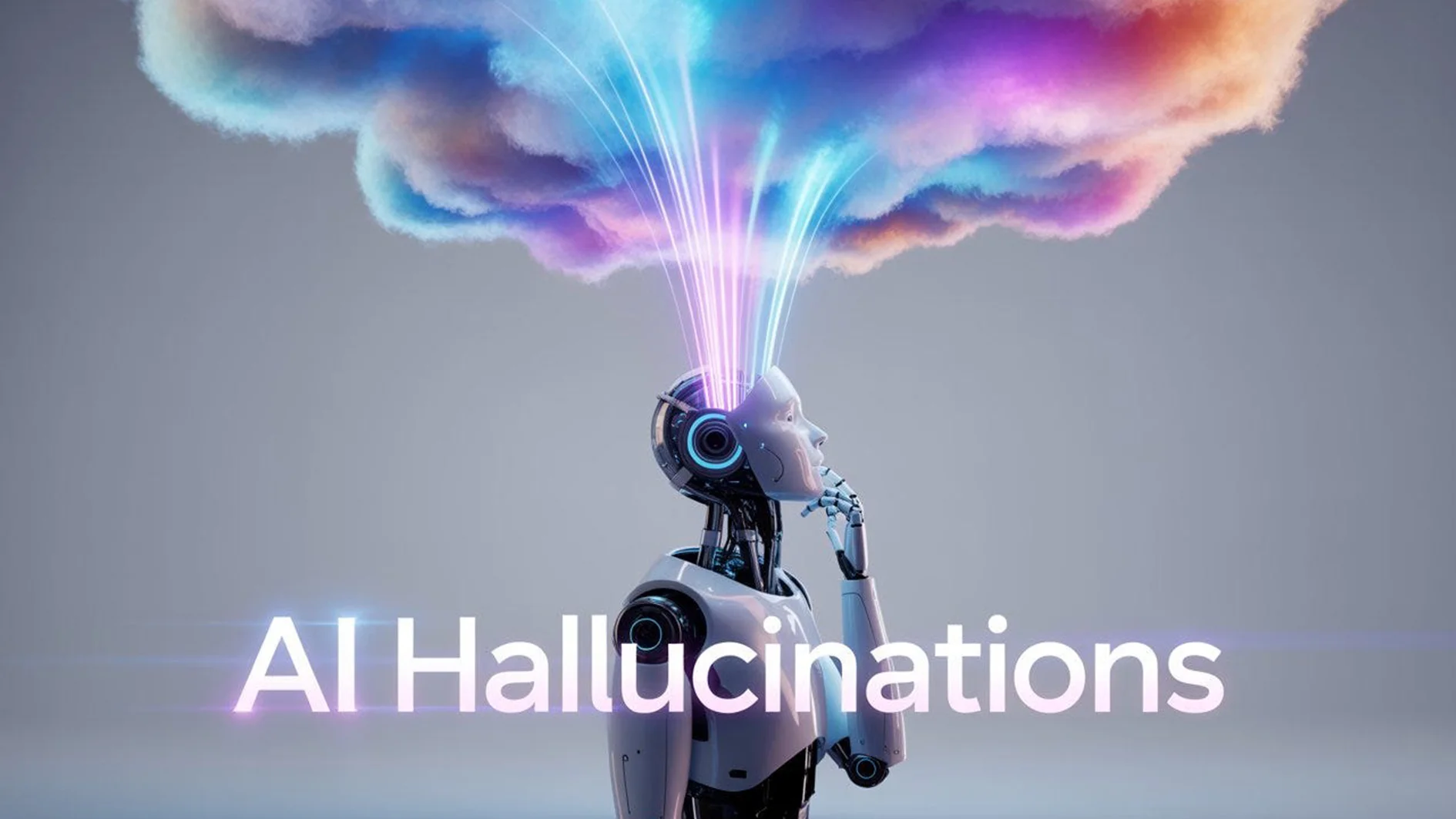
AI hallucination refers to a situation where an artificial intelligence model produces an output that does not match reality, available sources, or information provided to the model, even though the output may appear logical, well-written, and credible.
In recent years, generative AI tools have rapidly become part of everyday life and professional workflows. People now use AI systems to write articles, generate and review code, analyze information, and answer everyday questions. Despite these capabilities, one important problem remains: AI models can sometimes generate information that is inaccurate or completely fabricated while presenting it in a confident and seemingly authoritative way.
Imagine asking an AI assistant to provide a list of academic papers about a rare disease, including the authors, publication dates, and DOI identifiers. The model may produce a neatly formatted and highly convincing list within seconds. However, after checking the references, you may discover that some of the papers do not exist, several researchers have been incorrectly combined, or the DOI numbers are completely fabricated.
This is an example of a phenomenon known as AI hallucination.
Understanding this problem is important for anyone who relies on AI tools because a confident-sounding answer is not necessarily a correct one. In this article, we will explain exactly what AI hallucination is, why it happens, what forms it can take, and how you can reduce the likelihood and impact of inaccurate AI-generated information.
What Is AI Hallucination?
AI hallucination refers to a situation where an artificial intelligence model produces an output that does not match reality, available sources, or information provided to the model, even though the output may appear logical, well-written, and credible.
For example, a large language model (LLM) may correctly construct the name of a book, academic paper, person, or website from a linguistic perspective even though that source does not actually exist. It may also provide an incorrect date for an event, misreport statistics from a study, or give inaccurate details about a product.
Models such as ChatGPT, Claude, and Gemini do not understand "truth" in the same way humans do. They generate responses based on patterns learned from training data and information available to them at the time of answering. As a result, a response can contain several accurate statements alongside one or more completely false claims.
Why Is It Called a "Hallucination"?
The term hallucination is metaphorical in this context and should not be confused with the medical or psychological meaning of the word.
In AI, the term describes outputs that appear credible but are not supported by reality or reliable information. It is as if the system is presenting information without a genuine factual basis.
However, calling this phenomenon a hallucination does not mean that an AI model has a mind, emotions, consciousness, or human experiences. Language models operate through mathematical and statistical processes. Producing inaccurate information does not mean that the model is mentally experiencing a distorted version of reality.
Is AI Hallucination the Same as Lying?
No. There is an important distinction between hallucinating information and deliberately lying, and that distinction is related to intent.
In the ordinary sense, lying involves knowing or believing that something is false and deliberately presenting it as true in order to deceive someone. A language model does not have this kind of intention.
When a model generates incorrect information, it does not necessarily know that the information is false, nor does it have a goal of deceiving the user.
For this reason, terms such as hallucination, fabrication, or incorrect generation are technically more appropriate than saying that an AI model is "lying."
A Simple Example of AI Hallucination
Consider asking a language model:
"In what year did Computer Networking: A Top-Down Approach by James Kurose win the Nobel Prize in Literature?"
The question contains a false assumption. A technical networking textbook would not normally be a candidate for the Nobel Prize in Literature. An appropriate response should identify the incorrect premise instead of accepting it.
However, an AI model might respond with something such as:
"The book won the Nobel Prize in Literature in 2015 because of its accessible writing style and ability to explain complex networking concepts."
The sentence sounds natural, but the central claim is entirely fabricated.
In this situation, the model has failed to recognize the false premise and has instead generated a plausible-sounding continuation based on linguistic patterns associated with books, awards, and the Nobel Prize.
Why Does AI Hallucination Happen?
To understand why hallucinations occur, it helps to understand how language models generate responses.
Contrary to a common assumption, a language model does not function like an encyclopedia containing a perfectly organized collection of facts. When you ask a question, the model does not simply look up the correct answer from a database of verified information.
How Do Language Models Generate Responses?
Large language models are neural networks trained on enormous amounts of text. One of their fundamental capabilities is learning patterns between tokens and predicting what tokens are likely to come next based on the preceding context.
When a user enters a question, the model calculates probabilities for possible continuations and generates the response step by step.
This mechanism is fundamentally different from directly searching a verified database of facts.
As a result, a response can be fluent, coherent, and logically structured without every factual claim in it being correct.
Why Might a Model Invent an Answer When It Does Not Know?
Language models are generally optimized to respond to user requests. If a model does not have enough information about a subject, or if the question concerns something obscure, ambiguous, or outside its reliable knowledge, it may attempt to construct an answer from related patterns rather than simply saying that it does not know.
This can result in what is sometimes described as a plausible but false answer: an answer that appears reasonable but does not correspond to reality.
The Role of Training Data
The quality, diversity, and freshness of the data used to train a model can affect the quality of its responses. Several factors are particularly important:
Incomplete data: If insufficient information about a subject exists in the training data, the model may rely on generalization when answering.
Outdated information: Many areas of knowledge change continuously. If a model does not have access to recent information, it may answer current questions using outdated knowledge.
Conflicting sources: The internet contains contradictory claims and inaccurate information. Conflicting examples can make reliable generation more difficult.
Low-quality data: Rumors, misinformation, and unreliable material contained within training data can also affect the quality of generated responses.
Ambiguous User Prompts
The less precise a user's question is, the more room there is for incorrect interpretation.
If the model cannot determine exactly what the user wants, it may need to make assumptions. Those assumptions can introduce inaccurate information into the final response.
For example, asking:
"What is the best server for my website?"
does not provide enough information about the type of website, expected traffic, budget, software stack, or technical requirements. The model therefore has to make assumptions before giving an answer.
Context Window Limitations
Language models have a limit to how much information they can process within a given interaction. This is commonly referred to as the context window.
If a conversation or document becomes larger than the model can effectively process, the model may fail to account for some earlier information correctly.
Similarly, if important information was never provided to the model in the first place, it may attempt to fill the missing pieces using statistical patterns, potentially resulting in fabricated information.
Temperature and Generation Parameters
Temperature is a parameter used by some AI models and APIs to control the degree of randomness involved in token selection.
Higher temperature values generally allow for more variation in generated responses, while lower values tend to produce more predictable outputs.
Higher temperatures can be useful for creative tasks, while more conservative settings may be preferable when consistency and factual precision are more important.
However, lowering temperature does not eliminate hallucinations. A model can still generate incorrect information even with highly conservative generation settings because hallucination is not simply a consequence of randomness.

What Are the Different Types of AI Hallucination?
AI hallucinations can take several forms. They are not limited to completely fictional stories or obviously fabricated facts.
Some of the most common types include:
Factual hallucination: Generating incorrect statistics, dates, numbers, or events. For example, a model may provide the wrong date for a historical event.
Source hallucination: Citing a book, paper, report, or website that does not actually exist. Fabricated academic references and DOI numbers are particularly dangerous examples.
Quote hallucination: Attributing a statement, opinion, or theory to a person who never actually said it.
Entity hallucination: Confusing people, companies, brands, products, or locations with similar names or characteristics. A model may, for example, combine the career histories of two different executives.
Programming hallucination: Suggesting a library, function, API endpoint, or parameter that does not exist, even though its name sounds technically plausible.
Reasoning hallucination: Starting with some correct information but reaching an incorrect conclusion during the reasoning process.
Why Do Hallucinated Answers Look So Real?
The biggest danger of AI hallucination is not simply that incorrect information can be generated. It is the way that information is presented.
A model may state a false claim using exactly the same confident tone and polished structure it would use for a completely accurate fact.
Natural Language and Confident Tone
Language models are designed to produce natural, human-like text. Their responses are therefore usually fluent, organized, and grammatically polished.
Users can easily mistake this confidence and fluency for expertise.
If a model presents an incorrect claim using precise wording and a confident tone, the user may accept it without performing any additional verification.
More Detail Does Not Mean More Accuracy
Another reason hallucinated information can be convincing is the amount of detail a model may provide.
An AI system can generate an author's name, publication date, page number, article title, URL, or identifier that looks perfectly legitimate while being completely fabricated.
The presence of these details should not be treated as evidence that the underlying claim is accurate. In fact, precise and unexpected claims often deserve additional scrutiny.
The Problem of False Confidence
An AI model may introduce an answer with phrases such as:
"According to research published in 2023..."
or:
"According to a report published by..."
Such statements can create the impression that a reliable source exists. However, the existence of the claimed study or report must still be verified.
Simply mentioning a research paper, organization, or report does not prove that the source actually exists.
How Can You Tell If an AI Response Contains a Hallucination?
To avoid accepting fabricated information, AI responses should not automatically be treated as primary sources, especially when dealing with important or sensitive subjects.
Several practical methods can reduce the likelihood of accepting inaccurate information.
Practical Ways to Evaluate AI Output
Check the sources: If the model mentions a book, paper, or website, search for it independently through reliable sources.
Verify links: Open links provided by the model and confirm that the referenced page actually exists and supports the claim.
Verify academic references: Search DOI identifiers through established academic databases and verify that the paper, authors, title, and publication details match.
Compare against authoritative sources: Check statistics, dates, formulas, technical specifications, and important claims against reliable sources in the relevant field.
Compare multiple models: Asking the same question to different models can reveal significant disagreements that warrant further investigation. However, agreement between several models does not by itself prove that a claim is correct.
Ask for sources: Request sources for important claims, then independently verify those sources.
Watch for unusual details: Extremely precise statistics, surprising claims, or information that is difficult to verify should receive additional scrutiny.
A Simple Rule for Fact-Checking
If an AI system provides a claim that is highly specific, unusual, unexpected, or difficult to believe, do not treat it as fact until you have independently verified it through a reliable source.
Can AI Hallucination Be Prevented?
The short answer is that completely eliminating hallucinations from current language models is not possible.
However, better prompting, access to reliable sources, external tools, and systematic verification can significantly reduce both the frequency and impact of inaccurate outputs.
Practical Ways to Reduce Hallucinations
Write precise prompts: Clear and specific instructions leave less room for incorrect interpretation.
Provide the relevant information: If you already have a source document, provide it to the model and explicitly ask it to base the answer on that material.
Tell the model to acknowledge uncertainty: For example, you can instruct it to say that it does not know rather than inventing information when sufficient evidence is unavailable.
Request sources for important claims: This can make verification easier, although the sources themselves still need to be checked.
Use RAG: Connecting a model to a controlled knowledge base or document collection can help ground its responses in specific information.
Connect models to search and databases: Access to current information can be particularly useful for news, prices, statistics, and other rapidly changing subjects.
Use human review for sensitive outputs: Medical, legal, financial, and security-related information should receive appropriate expert review before being relied upon.
How Does RAG Help Reduce Hallucination?
One of the most common approaches to reducing hallucinations in AI applications is Retrieval-Augmented Generation (RAG).
Instead of relying solely on information learned during training, a RAG system retrieves relevant information from an external source before generating its answer.
The basic process can be represented as:
User Query
↓
Retrieval — Search the knowledge base or data source
↓
Relevant Documents — Retrieve supporting information
↓
LLM — Generate a response using the retrieved information
↓
Answer
In a RAG system, the user's query is first used to find relevant information within a knowledge base, search engine, document repository, or other external source.
The retrieved material is then provided to the language model so it can generate a response based on that information.
This approach is particularly useful when an AI system needs to answer questions based on a specific collection of documents, such as technical documentation, internal company knowledge, product information, or research papers.
However, RAG is not a perfect solution.
The retrieval system may select incomplete or irrelevant documents. Even when the correct documents are retrieved, the language model may still misunderstand, misinterpret, or incorrectly summarize them.
RAG can therefore reduce the probability of hallucination, but it cannot guarantee that every generated answer will be correct.
Do ChatGPT, Gemini, and Claude Also Hallucinate?
Yes. No large language model can currently be considered completely immune to generating inaccurate information.
The frequency and type of errors can vary depending on the model, version, question, available sources, and tools connected to the system.
Hallucination in Major AI Models
ChatGPT, Gemini, and Claude can all produce inaccurate information under certain circumstances.
Highly specialized questions, very recent events, obscure sources, and requests requiring precise citations can all create situations where hallucinations are more likely to occur.
Differences between models are generally related to the frequency and type of errors they make, their training methods, access to external tools, and performance on specific tasks.
Therefore, the name of a particular model should not be treated as a guarantee that its answers are always more reliable than those of other systems.
Is There a Completely Hallucination-Free AI Model?
No.
There is currently no language model that can guarantee a zero hallucination rate across all tasks and circumstances.
This does not mean that all models perform equally. Different models can have substantially different error rates depending on the task, and tools such as web search, RAG, structured databases, and verification systems can improve factual accuracy.
The Impact of AI Hallucination on Content Creation and SEO
AI can significantly accelerate research, writing, and content production. However, publishing AI-generated material without fact-checking can damage the credibility of a website.
Risks of Hallucination in SEO and Content
Incorrect information: Publishing false claims can reduce reader trust.
Fabricated sources and links: Referring to nonexistent articles or websites can undermine the credibility of an entire piece of content.
Invented statistics: Using numbers without verifying their original source can make an article unreliable.
Entity confusion: Mixing information about different companies, products, or individuals can produce misleading content.
Reduced content credibility: Repeated factual errors can damage audience trust and the perceived quality of a website.
Why Is Fact-Checking AI-Generated Content Important?
AI-generated content should be reviewed for factual accuracy just like any other content.
This becomes especially important for technical and specialized articles. A small mistake involving a product specification, statistic, date, technical instruction, or research reference can undermine the credibility of an otherwise useful article.
Using AI for research and writing therefore does not eliminate the need for verification. Writers should independently check important claims, sources, statistics, and sensitive information before publication.
Is AI-Generated Content Automatically Bad for SEO?
No.
Using AI does not automatically make content low-quality or unsuitable for search engines. The more important factors are the quality, usefulness, originality, accuracy, and value of the final content.
AI-generated material can become problematic when it is inaccurate, repetitive, shallow, or produced without meaningful review or added value.
On the other hand, using AI for research, brainstorming, outlining, and assisting with content creation can be part of a professional workflow when the resulting material is properly reviewed and edited.
Which Fields Are Most Vulnerable to AI Hallucination?
The potential consequences of hallucination vary significantly between fields.
An inaccurate statement in an entertainment article may have little practical impact. The same level of inaccuracy in a medical or financial context can have serious consequences.
|
Field |
Risk Level |
Why It Matters |
|---|---|---|
|
Medicine and healthcare |
Very high |
Incorrect information or advice can affect a person's health and safety. |
|
Law and legal matters |
Very high |
Fabricated laws, cases, or citations can have serious legal consequences. |
|
Finance and investment |
Very high |
Incorrect analysis or statistics can lead to financial losses. |
|
Cybersecurity |
High |
Incorrect code or security configuration can expose systems to vulnerabilities. |
|
Software development |
Medium to high |
Nonexistent APIs, libraries, or incorrect code can cause failures or security problems. |
|
Content creation and SEO |
Medium |
Inaccurate information can damage the credibility of content and brands. |
|
Entertainment and game development |
Low |
Incorrect output can often be treated as an idea and evaluated before use. |
Famous Real-World Examples of AI Hallucination
AI hallucination is not merely a theoretical problem. Several real-world incidents have demonstrated the consequences of relying on AI-generated information without proper verification.
The Mata v. Avianca Case
In 2023, attorneys involved in a U.S. legal case used ChatGPT during the preparation of legal documents.
The model generated several legal cases and citations that did not actually exist. The fabricated references were included in documents submitted to the court before the problem was discovered.
The incident became one of the best-known examples of why AI-generated legal information must be independently verified before being used in professional settings.
Google Bard's James Webb Telescope Error
During the public introduction of Google's Bard, the model gave an incorrect answer about discoveries made by the James Webb Space Telescope.
The response incorrectly claimed that the telescope had taken the first images of planets outside our solar system.
The error attracted significant attention and demonstrated that even a highly capable AI system can generate inaccurate factual claims during a public demonstration.
Does Hallucination Mean AI Is "Stupid"?
No.
AI hallucination should not simply be interpreted as evidence that a model is unintelligent. The problem is largely related to the difference between statistical language generation and human understanding of the world.
A language model can perform extremely well on a complex programming task while making a surprisingly simple mistake about the release date of a product.
This may seem contradictory, but the behavior reflects differences between the tasks the model has learned to perform and the way it generates answers.
Therefore, strong performance on one task does not guarantee factual accuracy on every other task.
How Can We Use AI More Reliably?
Professional use of AI benefits from having a defined process for reviewing generated information.
A simple workflow can look like this:
Ask → Request Sources → Verify → Cross-check → Use
A Standard Workflow for AI-Assisted Content Creation
Step 1 — Research: Use AI for brainstorming, identifying relevant topics, and creating an initial structure.
Step 2 — Gather sources: Ask for sources supporting important claims and factual statements.
Step 3 — Verify sources: Check links, names, statistics, dates, and academic identifiers against the original sources.
Step 4 — Separate verified information: Distinguish facts that have been independently confirmed from suggestions or information generated by the AI.
Step 5 — Create the content: Write the final material using verified information as the foundation.
Step 6 — Perform a final review: Read the entire article and verify important claims before publication.
Step 7 — Publish: Release the content only after its factual accuracy and overall quality have been reviewed.
The Future of AI and Hallucination
Reducing hallucination is one of the major challenges in the development of AI systems.
As models improve, gain better access to external sources, and use more sophisticated verification methods, the frequency of certain types of errors is likely to decrease.
However, expecting hallucinations to disappear completely would be unrealistic.
Language models remain systems that generate outputs based on learned patterns, and under certain circumstances they can still produce inaccurate information.
Will AI Hallucination Eventually Disappear?
Future models will likely become better at recognizing uncertainty, using external sources, and evaluating their own responses.
However, there is currently no reason to assume that hallucination will disappear completely.
A more realistic goal is to reduce the probability of errors and build systems that can recognize when they lack sufficient information and explicitly communicate that uncertainty instead of inventing an answer.
Key Technologies for Reducing Hallucination
Improved RAG: Better retrieval systems can provide models with more relevant and reliable information.
Web search: Connecting models to live sources can help verify information that changes frequently.
AI agents: Agent-based systems can divide complex tasks into multiple steps and, depending on their architecture, evaluate intermediate results.
Verification and grounding: Connecting models to trusted databases, knowledge graphs, and authoritative sources can improve the factual grounding of responses.
Human review: In high-risk applications, human oversight remains one of the most important layers of quality control.
Ultimately, the future of AI is not simply about building larger models with more parameters.
A significant part of AI development is focused on creating systems that can connect their answers to reliable sources, current data, and verifiable information.
AI hallucination will likely remain an important limitation of language models for some time. However, combining better models with reliable sources, search tools, RAG systems, and systematic fact-checking can significantly reduce both the frequency and consequences of inaccurate AI-generated information.
Frequently Asked Questions
What is AI hallucination?
AI hallucination is a situation where an AI model generates information that is inaccurate, fabricated, or unsupported by reliable evidence while presenting it in a convincing and coherent way. The output may include invented facts, sources, quotes, statistics, or other details that appear legitimate but do not match reality.
Why does AI hallucinate?
AI models generate responses based on patterns learned from data rather than retrieving every answer from a verified database of facts. Incomplete or outdated information, ambiguous prompts, conflicting sources, limited context, and the model's inability to reliably determine whether every generated statement is true can all contribute to hallucination.
Can AI hallucination be prevented?
It cannot currently be prevented completely, but its likelihood and impact can be reduced. Clear prompts, reliable source material, retrieval systems, web search, RAG, lower-risk generation settings, and human fact-checking can all improve the reliability of AI-generated responses.
How can you identify an AI hallucination?
Check the model's claims against reliable primary or authoritative sources. Pay particular attention to names, dates, statistics, quotations, URLs, academic references, DOI identifiers, and highly specific claims. A confident tone or a large amount of detail should not be considered proof that the information is accurate.
Do all AI models hallucinate?
All current large language models can produce inaccurate or fabricated information under certain circumstances. The frequency and severity of hallucinations vary between models and tasks, but no widely used language model can guarantee perfectly accurate answers in every situation.
Does AI always use real information when answering questions?
No. Depending on the system and its configuration, an AI model may generate an answer using information learned during training, information provided in the conversation, or information retrieved from external tools. If the model does not have access to current or relevant sources, it may provide an answer based on incomplete or outdated information.